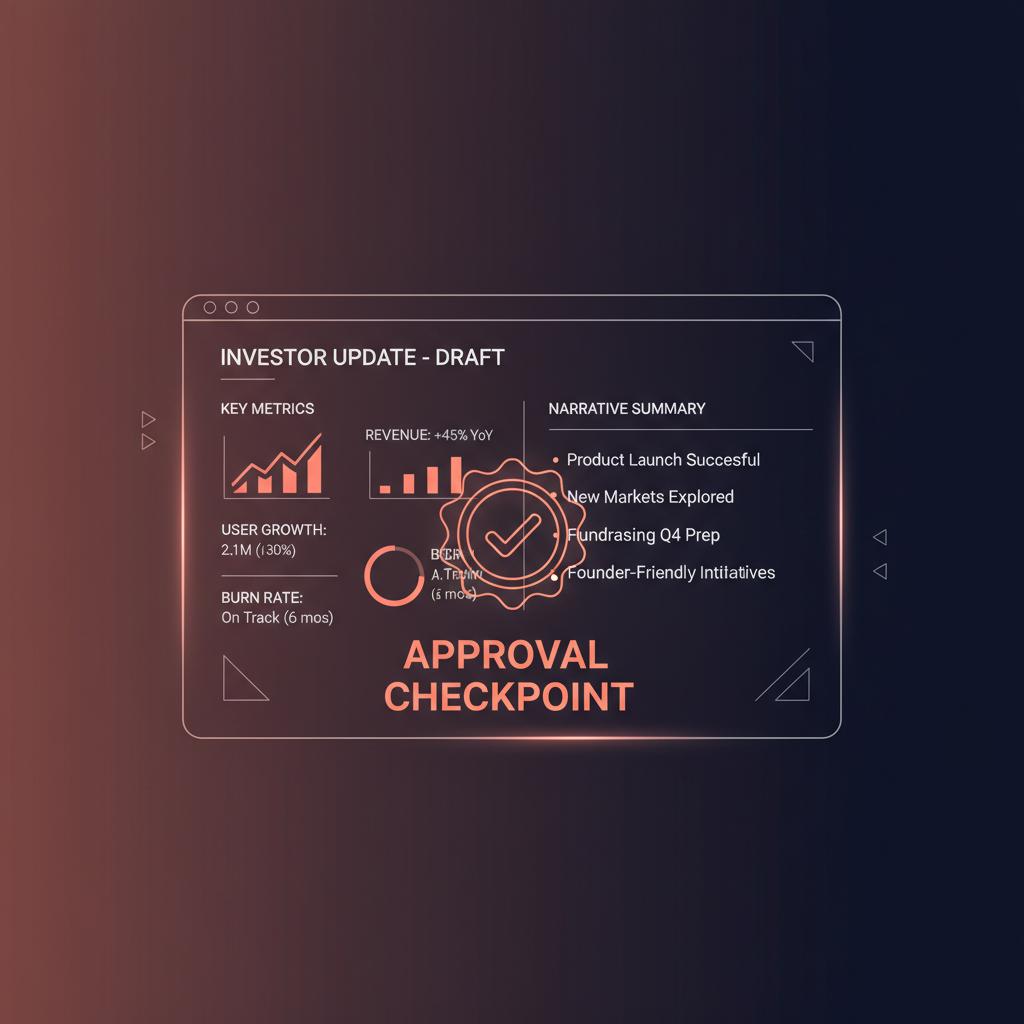
Monthly investor updates are one of the highest-leverage habits for founders - when they’re done well. Visible reports that startups that provide regular investor updates are 3x more likely to receive follow-on funding, and companies that communicate consistently with current investors are twice as likely to raise follow-on funding. Yet only 40% of founders update their investors quarterly, and 60% of investors don’t hear from portfolio companies on a regular basis. That gap is an opportunity. The bottleneck is usually time: pulling metrics, writing the narrative, and sending on a cadence. An AI executive assistant can draft your update from your data and context - then you edit and send, so it stays in your voice. Here’s how to automate investor updates without sounding like a bot.
Investor updates keep your backers informed, build trust, and make it easier to ask for help (intros, advice, follow-on). Best practice is monthly for seed and pre-seed; many Series A companies shift to quarterly. The payoff is real: regular communicators stand out in a world where most investors don’t hear from founders consistently.
Founders skip updates because they’re time-consuming. You need to gather metrics (revenue, burn, runway, key KPIs), summarize wins and challenges, write a narrative that’s concise and honest, and often tailor or track who got what. Doing that manually can take half a day per month. Tools like Visible and custom “self-assembling” systems (e.g. the approach in Rami’s “The Investor Update That Builds Itself” on Action Potential) cut that to 30 minutes or less by pulling data and generating a first draft. The missing piece for many founders is who drafts and who sends - you want a draft you can edit, not an auto-sent template. That’s where an approval-first AI assistant fits.
Effective updates are usually:
- Short - 90 seconds to read, 5 minutes for depth (Visible, Fundreef).
- Metrics-first - revenue, burn, cash, and a few key KPIs before long narrative.
- Honest - bad news and risks upfront, not buried.
- Actionable - specific asks (intros, feedback, follow-on) so investors know how to help.
Templates like Y Combinator’s (highlights, metrics, challenges, asks) work well. The goal is consistency and clarity, not length. An AI assistant can help by drafting a first pass from your numbers and notes - then you tighten the tone and add the nuance only you have.
An AI executive assistant can:
- Pull context from your tools - e.g. recent emails about metrics, board or investor threads, or a short “update notes” doc you keep.
- Draft a narrative that follows your usual structure (metrics, wins, challenges, asks).
- Queue the draft for your approval - no send until you review and edit.
You stay in control: the assistant proposes; you approve or change. That’s the same approval-first model that works for email and calendar - nothing goes out without you. So your update still sounds like you; you’re just not starting from a blank page.
Some founders go further and wire an AI skill or workflow to APIs (e.g. Stripe, your dashboard) to pull numbers into a structured brief, then have the assistant turn that into prose. Others keep it simple: a short bullet list of metrics and highlights, and the assistant drafts the email. Either way, the principle is draft → you edit → you send.
- Keep metrics accurate - If the assistant pulls from a doc or your notes, make sure the numbers are right before it drafts. Garbage in, garbage out.
- Edit the draft every time - Use the AI output as a starting point. Add the one or two things that only you know (e.g. a tough conversation, a strategic pivot).
- Use a consistent format - Same sections (highlights, metrics, challenges, asks) and similar length so investors know what to expect.
- Don’t auto-send - Always approve the final text. One misstated metric or tone-deaf line can cost trust.
Alyna fits this workflow: it can draft from context you provide (email threads, a brief, or past updates) and put the draft in your queue. You review, edit, and send from your own inbox - so automation doesn’t mean losing your voice.
If you’re already doing monthly updates manually, try this: next cycle, write down your key metrics and 3–5 bullet highlights and challenges. Ask your AI assistant to draft a one-page update from that. Edit it, then send. If that saves you an hour, add more structure (e.g. a recurring “investor update” prompt or doc) and iterate. The goal isn’t to hand off the relationship - it’s to protect time so you can keep the habit without it eating a full day. For more on how founders use AI for high-leverage tasks, see how AI executive assistants save time and approval workflows for executives.
Alyna drafts investor updates (and email, calendar, and meeting prep) for your approval - nothing sends without you. Get access.