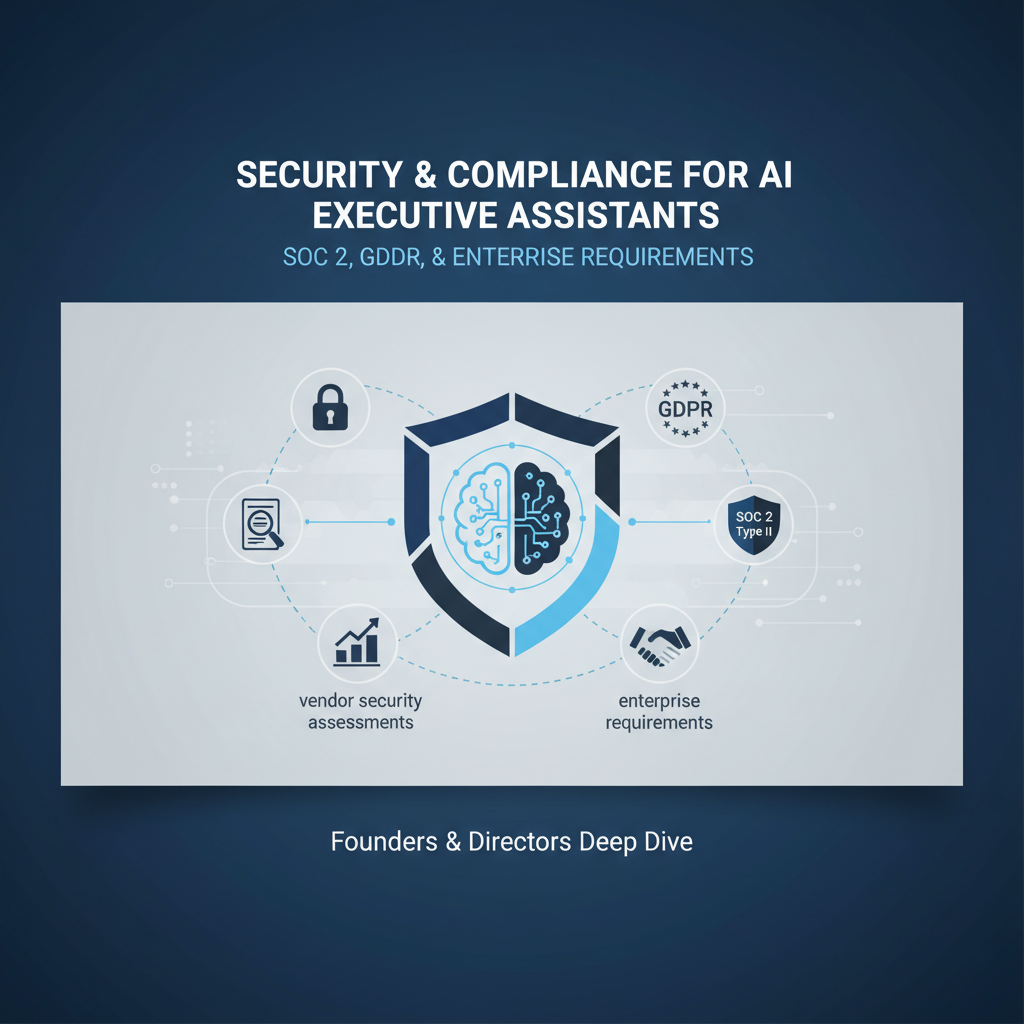
When evaluating AI executive assistants for enterprise use, security and compliance aren't optional - they're foundational. Your assistant will have access to sensitive data: customer communications, contracts, strategic discussions, financial information. This data must be protected with enterprise-grade security and compliance with relevant regulations. For executives comparing solutions, see our security-focused comparison and approval workflow guide that covers audit trails and control.
This guide covers what executives need to know about security and compliance when evaluating AI assistants, without getting into technical implementation details. The focus is on what matters for decision-making.
AI executive assistants process highly sensitive data. They read your emails, which may contain customer communications, contract negotiations, and strategic discussions. They access your calendar, which shows meeting details, attendee information, and your schedule patterns. They monitor your Slack or Teams messages, which may include internal discussions and planning.
This data sensitivity requires enterprise-grade security. The assistant must encrypt data at rest and in transit, use secure authentication methods, maintain access controls, and provide audit trails. Without proper security, sensitive information could be exposed, leading to data breaches, compliance violations, and reputational damage.
The compliance requirements are equally important. Depending on your industry and location, you may need to comply with GDPR (if you have EU customers), SOC 2 (for enterprise customers), HIPAA (if you handle healthcare data), or other regulations. The AI assistant must support these compliance requirements.
SOC 2 (Service Organization Control 2) is an auditing framework that ensures service providers securely manage customer data. Type II certification requires the vendor to demonstrate ongoing operational effectiveness over 6-12 months, not just point-in-time controls.
SOC 2 evaluates five trust service criteria: security, availability, processing integrity, confidentiality, and privacy. A vendor with SOC 2 Type II certification has been independently audited and verified to meet these criteria consistently.
For executives evaluating AI assistants, SOC 2 Type II certification is a strong indicator of security maturity. It shows the vendor takes security seriously, has proper controls in place, and maintains them over time. You should ask vendors for their SOC 2 Type II report and review it as part of your evaluation. This is especially important when comparing different AI assistant solutions for enterprise use.
The report will show you how the vendor handles access controls, encryption, incident response, and other security measures. While you don't need to understand every technical detail, you should verify that the vendor has proper security controls and that they're maintained consistently.
If you have customers or operations in the European Union, GDPR compliance is required. GDPR (General Data Protection Regulation) governs how personal data is collected, processed, and stored. AI assistants that process personal data must comply with GDPR requirements.
Key GDPR requirements include: lawful basis for processing data, data subject rights (access, correction, deletion), data protection by design and default, and data breach notification. The AI assistant must support these requirements through its design and operations.
For executives, the important questions are: does the vendor comply with GDPR, how do they handle data subject requests, and what's their process for data deletion? You should ask vendors for their GDPR compliance documentation and data processing agreements.
You should also understand where your data is stored. GDPR requires that personal data of EU residents be stored within the EU or in countries with adequate data protection. The vendor should be able to tell you where data is stored and support data residency requirements if needed.
Data encryption protects your information from unauthorized access. Data should be encrypted both at rest (when stored) and in transit (when transmitted). Industry standards are AES-256 encryption for data at rest and TLS 1.3 for data in transit.
For executives, the important point is that your data is protected with industry-standard encryption. You don't need to understand the technical details, but you should verify that the vendor uses appropriate encryption standards and that encryption keys are managed securely.
You should also understand who has access to your data. Even with encryption, the vendor's employees might have access to your data for support or operations. You should ask about access controls, who has access, and how access is monitored and audited.
Audit trails are logs of all actions taken by the AI assistant. They show what was proposed, who approved it, when it was executed, and what the result was. These logs are essential for compliance, security investigations, and understanding what happened if something goes wrong.
For executives, audit trails provide accountability and transparency. You can see exactly what the AI did, when it did it, and who approved it. This is important for compliance with regulations that require activity logging, and it's useful for understanding and improving AI behavior.
You should ask vendors about their audit trail capabilities. What gets logged? How long are logs retained? Can you export logs? Are logs searchable? These capabilities are important for compliance and operational needs.
When evaluating AI assistant vendors, you should conduct a security assessment. This doesn't need to be a technical deep-dive, but you should ask key questions about security, compliance, and data handling.
Ask about security certifications. Does the vendor have SOC 2 Type II? What other security certifications do they have? These certifications show that the vendor has been independently verified to meet security standards.
Ask about data handling. Where is data stored? How is it encrypted? Who has access? How is access controlled and monitored? These questions help you understand how your data is protected.
Ask about compliance. Does the vendor comply with GDPR? Do they have data processing agreements? Can they support your specific compliance requirements? These questions ensure the vendor can meet your compliance needs.
Ask about incident response. What's their process for security incidents? How quickly do they notify customers? What's their breach notification process? These questions help you understand how the vendor handles security issues.
There are several red flags that should cause you to avoid a vendor. If a vendor cannot provide SOC 2 Type II reports, that's a concern. If they cannot explain their data encryption, that's a problem. If they don't have clear incident response procedures, that's a risk.
If a vendor refuses to sign data processing agreements (DPAs) required for GDPR compliance, that's a deal-breaker for EU operations. If they cannot explain where data is stored or cannot support data residency requirements, that may be a problem depending on your needs.
If a vendor cannot provide security documentation or is evasive about security questions, that's a major concern. Enterprise vendors should be transparent about security and happy to provide documentation. Secrecy about security is a red flag.
When evaluating vendors, ask these key questions: Do you have SOC 2 Type II certification? Can I review the report? How is my data encrypted? Where is my data stored? Do you support GDPR compliance? What audit trails do you maintain? How do you handle security incidents? What's your breach notification process?
The vendor should be able to answer these questions clearly and provide documentation. If they cannot, that's a concern. Enterprise vendors should have comprehensive security documentation and be able to explain their security measures clearly.
You should also ask about their security team and processes. Do they have dedicated security staff? How often do they conduct security audits? What's their vulnerability management process? These questions help you understand the vendor's security maturity.
If you're evaluating AI assistants for enterprise use, security and compliance should be top priorities. Start by asking vendors for their security documentation, SOC 2 reports, and compliance certifications. Review these as part of your evaluation.
Work with your IT and compliance teams to ensure the vendor meets your specific requirements. They can help you understand technical details and verify that the vendor's security measures meet your standards.
The goal is to find an AI assistant that provides the productivity benefits you need while meeting your security and compliance requirements. Good vendors will be transparent about security and happy to provide documentation. If a vendor is evasive or cannot provide security documentation, that's a sign to look elsewhere.
Alyna is SOC 2 Type II certified, GDPR compliant, and provides comprehensive security documentation for enterprise customers. Request our security packet and SOC 2 Type II report for your vendor assessment.