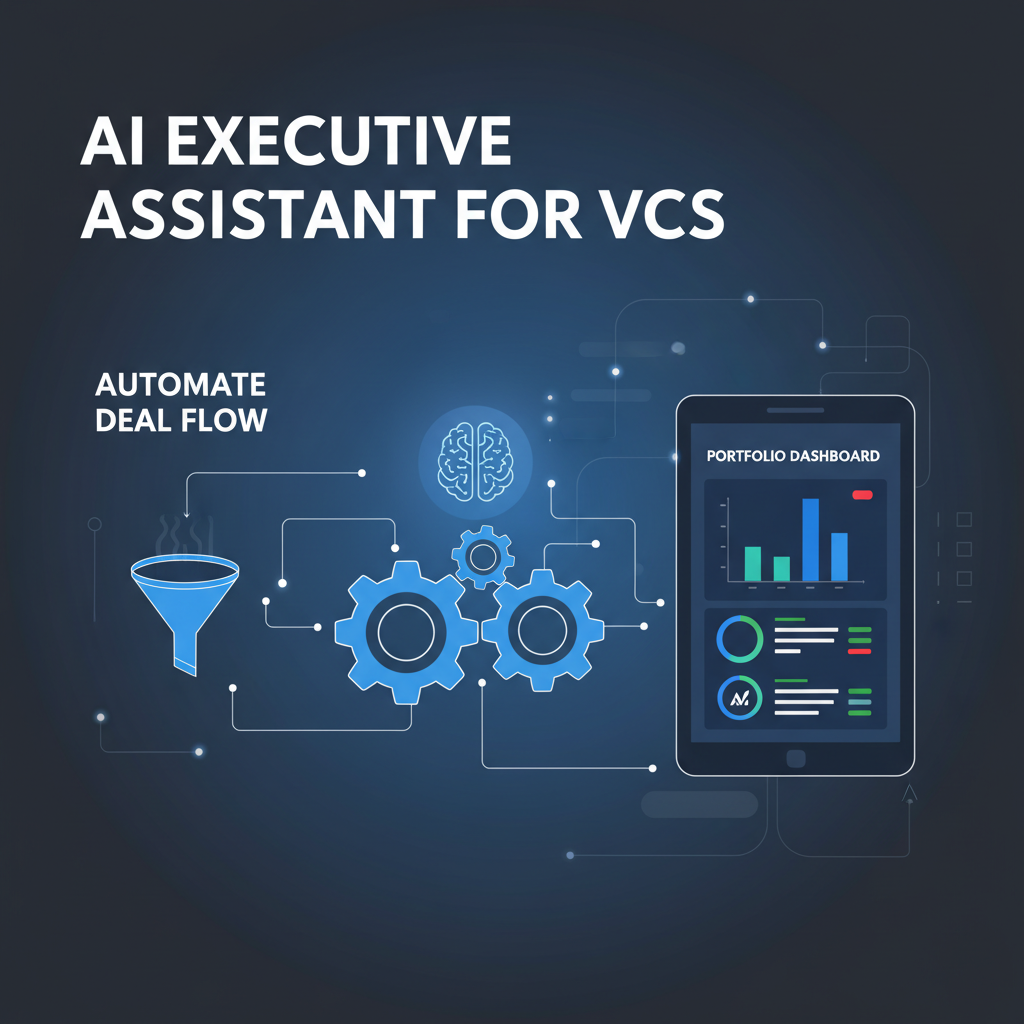
Venture capital partners are drowning in email and deal flow. The average early-stage VC gets 6,200+ cold emails monthly (200/day), spends hours triaging pitch decks, and manually tracks portfolio company metrics across dozens of spreadsheets and folders - all while trying to find time for what actually matters: founder relationships, strategic calls, and investment decisions.
AI assistants built for VCs can automate 60-70% of this workflow: triage inbound deals, research companies, monitor portfolios, brief you before meetings, and surface relationship intelligence - without missing opportunities. This guide covers how top VCs are using AI assistants to win back 15-20 hours weekly, improve deal quality, and stay on top of portfolios.
Let's start with what's broken:
- 200 emails/day, most from founders pitching
- 15 seconds per email to triage, but fear of missing the next breakout
- Manually tracking which deals you've seen, responded to, passed on, or flagged for follow-up
- No consistent scoring or criteria - every partner has different instincts
Once a deal passes initial triage:
- Dozens of pitch decks, financials, and legal docs in Google Drive, Dropbox, Notion, Slack
- Finding specific details ("What was their CAC in Q3?") requires digging through files
- Version control nightmares (which deck was the latest?)
- Manual research: competitor analysis, market sizing, founder background checks
Post-investment:
- Chasing portfolio companies for monthly/quarterly updates
- Manually extracting KPIs from investor update emails, decks, and spreadsheets
- Consolidating metrics across 10-50 portfolio companies
- Identifying which companies need attention vs which are on track
- Past founders who were "too early" but are now at the right stage
- Warm intros sitting in your network that you're not leveraging
- LP relationships and co-investor networks not systematically tracked
- No way to surface "this founder worked with someone you invested in 3 years ago"
Result: VCs spend 60-70% of their time on tactical grunt work (email triage, data entry, research, tracking) instead of strategic work (building relationships, advising portfolio, making investment decisions).
An AI executive assistant for VCs automates the tactical layer: triage, research, monitoring, briefing, and relationship intelligence. You focus on judgment and relationships; AI handles the volume.
Here's how it works:
- 200 emails/day → 30 minutes of triage
- Manually read pitch, check if it fits thesis, flag if interesting
- Reply "thanks, not a fit" or "let's schedule a call"
- Track in spreadsheet or CRM
- AI reads every inbound pitch (email, form submission, deck attached)
- Scores against your criteria: sector, stage, geography, traction, team, thesis fit
- Flags top 5-10% for your review ("strong fit, 3M ARR, B2B SaaS, ex-Stripe founder")
- Drafts replies for the rest ("thanks, not a fit right now" or "we're not investing in X space")
- You review and approve before anything sends
Time saved: 25 minutes/day → 2-3 hours weekly
Alyna's deal flow workflow:
- Multi-agent research: one agent reads the deck, another researches the company (website, LinkedIn, Crunchbase, news), a third agent checks for warm connections in your network
- Scoring: AI applies your thesis (e.g., "B2B SaaS, $1M+ ARR, $5M+ TAM, founder has domain expertise")
- Briefing: "3 strong fits this week: Company A (ex-Stripe, $2M ARR SaaS), Company B (warm intro via Portfolio Co X), Company C (Series A, growth stage SaaS)"
- You decide: "Schedule calls with A and B, pass on C"
When a new deal comes in, AI checks:
- "Have I seen this founder before?" (past meetings, intros, passes)
- "Do we have mutual connections?" (your portfolio, LPs, co-investors, advisors)
- "Who can intro us?" (Alyna can search LinkedIn, email history, CRM)
Result: Cold pitches become warm intros; you prioritize relationships over volume.
- Founder sends pitch deck + financials + data room
- You manually read 20-40 pages, extract key metrics, flag questions
- Research competitors, market size, team background (Google, LinkedIn, Crunchbase)
- Consolidate notes into memo or spreadsheet
- Time: 2-4 hours per deal
- AI reads pitch deck, financials, data room (PDFs, slides, sheets)
- Extracts KPIs: ARR, growth rate, CAC, LTV, burn, runway, cap table
- Researches company: website, product, news, social proof, Crunchbase, Pitchbook
- Researches founders: LinkedIn, past companies, domain expertise, exits
- Researches competitors: "Who else is in this space? How does traction compare?"
- Synthesizes into brief: "Company A: $2M ARR, 15% MoM growth, $200 CAC, $2k LTV, 18mo runway. Founder: ex-Stripe PM, 2nd-time founder (first exit $8M). Market: $5B TAM, 3 main competitors (Company X $50M ARR, Y $10M, Z $5M). Key risk: burn rate high, need to prove unit economics by Series A."
- You review, ask follow-ups, schedule call
Time saved: 1.5-3 hours per deal → 6-12 hours/week if you're reviewing 4-6 deals weekly
Alyna's diligence workflow:
- Multi-agent coordination: Research agent scrapes web + LinkedIn + Crunchbase; analysis agent extracts metrics from deck; synthesis agent writes the brief
- Browser control: Alyna's remote browser navigates to competitor websites, pricing pages, LinkedIn, news articles - extracts data automatically
- Web search: Finds latest funding rounds, product launches, hiring activity, sentiment
- Approval-first: You see the brief, ask questions ("What's their churn rate?"), AI digs deeper
- Portfolio companies send monthly investor updates (email, Notion, slide deck)
- You manually read each update, extract KPIs (ARR, burn, runway, hires), copy into spreadsheet
- Consolidate across 10-50 portfolio companies
- Identify which companies need attention: runway < 6mo, growth slowing, hiring challenges
- Time: 2-4 hours/month per company → 20-100 hours/month for a 20-company portfolio
- AI reads investor updates (email, PDF, Notion link, slide deck)
- Extracts KPIs automatically: ARR, MRR, growth rate, CAC, LTV, burn, runway, headcount, key hires, fundraising status
- Populates dashboard: Auto-updated portfolio tracker (Notion, Airtable, Google Sheets)
- Flags issues: "Company X runway down to 4 months, recommend check-in" or "Company Y missed growth target 2 quarters in a row"
- Briefs you weekly: "3 portfolio companies need attention this week: X (runway), Y (growth), Z (co-founder departure). 5 on track. 2 ahead of plan (Company A raised Series B, Company B hit $10M ARR)."
Time saved: 15-90 hours/month (depending on portfolio size)
Alyna's portfolio workflow:
- Multi-agent processing: One agent per portfolio company, all running in parallel
- Heartbeat monitoring: Check investor update emails weekly, auto-populate KPIs
- Web search: If a company doesn't send an update, AI checks their blog, LinkedIn, press releases for traction signals
- Approval-first alerting: "Company X runway flagged - review investor update before scheduling call?"
Real-world impact: AI portfolio monitoring reduces 95% of manual KPI extraction time. VCs spend 5-10 minutes weekly reviewing dashboard instead of 15-20 hours monthly chasing updates.
Before every founder call or LP meeting:
- Re-read pitch deck, notes from last call, email thread
- Check LinkedIn, company website, recent news
- Prepare questions based on last conversation
- Time: 10-20 minutes per meeting → 2-4 hours/week for 10-15 meetings
- AI briefs you before every meeting:
- "Founder call at 2pm: Company A, $2M ARR SaaS, ex-Stripe PM, last spoke 3 months ago (they were pre-revenue, now at $200k MRR). Key questions: unit economics, go-to-market, team hires. Warm intro via Portfolio Co X."
- Context from past conversations: AI remembers what you discussed, flagged concerns, follow-up asks
- Latest traction: AI checks website, LinkedIn, news for updates since last call
- Suggested questions: Based on stage, sector, and your investment criteria
Time saved: 8-15 minutes per meeting → 2-3 hours/week
Alyna's meeting prep workflow:
- Unlimited memory: Remembers every founder conversation, concern, follow-up
- Web research: Checks company website, LinkedIn, Crunchbase, news before each call
- Heartbeat briefs: Automated 30-minute-before-meeting brief: "Here's who you're talking to, what you discussed last time, what's changed since then, and 3 questions to ask."
- New deal comes in; you think "Do I know anyone who knows this founder?"
- Manually search email, LinkedIn, CRM, portfolio company intros
- Ask around: "Anyone know X?" (Slack, text)
- Time: 5-15 minutes per deal, often skipped due to effort
- AI checks every inbound deal for warm connections:
- "This founder worked at Company Y (your portfolio company)"
- "Your LP Jane invested in their last company"
- "Your co-investor John introduced you to their co-founder 2 years ago"
- Surfaces intro path: "Warm intro via Portfolio Co CEO Sarah (they worked together at Stripe)"
- Drafts intro request: "Hey Sarah, I'm looking at Company X (ex-Stripe, B2B SaaS). I see you worked with their founder - any thoughts? Worth a call?"
Time saved: 10-20 minutes per deal → 2-4 hours/week
Deal quality improvement: Warm intros convert 3-5x higher than cold outreach
Alyna's relationship intelligence:
Quarterly LP updates:
- Consolidate portfolio metrics across 10-50 companies
- Write narrative update: new investments, exits, portfolio highlights, market trends
- Format deck or PDF, send to 20-100 LPs
- Time: 8-20 hours per quarter
- AI consolidates portfolio data from KPI dashboard (see Use Case 3)
- Drafts LP update: "Q4 2025: 3 new investments (Company A $2M seed, B $5M Series A, C $3M seed). Portfolio highlights: Company X hit $10M ARR (up 3x YoY), Company Y raised $20M Series B, Company Z exited for $50M. Market trends: AI tooling and vertical SaaS seeing strong momentum."
- Formats report (Notion doc, PDF, slides)
- You review, edit, approve before sending
Time saved: 6-15 hours per quarter
Alyna's LP reporting workflow:
- Multi-agent synthesis: Data agent pulls KPIs, narrative agent writes update, formatting agent creates deck
- Approval-first: You review draft, edit tone, add personal insights, approve send
Here's what a modern AI assistant for VCs can handle:
- Inbox triage: Sort 200 emails/day, flag top 10%, draft replies
- Deal flow scoring: Score every pitch against your thesis, flag strong fits
- Due diligence research: Read decks, research companies/founders/competitors, synthesize briefs
- Portfolio monitoring: Extract KPIs from investor updates, auto-populate dashboard, flag issues
- Meeting prep: Brief before every founder/LP call with context, questions, updates
- Relationship intelligence: Surface warm connections, draft intro requests
- Multi-agent workflows: Spin up specialized agents (research, analysis, drafting) for complex tasks
- Browser control and automation: Navigate websites, extract data, monitor competitors, track news
- Web search: Real-time research, market trends, company traction signals
- Unlimited memory: Learn your network, investment criteria, portfolio context over time
- Heartbeat monitoring: Check portfolio updates weekly, brief daily, alert on issues
- Approval-first workflows: Nothing sends without your review
- Email (Gmail, Outlook) for triage and drafting
- Calendar (Google, Outlook) for scheduling and meeting prep
- CRM (Affinity, Folk, Airtable) for deal tracking and relationship intelligence
- Data rooms (Google Drive, Dropbox, Notion) for diligence doc processing
- Messaging (Slack, WhatsApp, Telegram) for founder and team communication
Average VC partner time allocation (before AI):
- Email triage: 30 min/day = 2.5 hr/week
- Deal flow review: 3-5 hr/week
- Due diligence research: 6-12 hr/week (4-6 deals)
- Portfolio monitoring: 4-20 hr/month (5-25 hr/week annualized depending on portfolio size)
- Meeting prep: 2-3 hr/week
- LP reporting: 8-20 hr/quarter (2-5 hr/week annualized)
Total tactical work: 20-35 hr/week
With AI assistant:
- Email triage: 5 min/day = 25 min/week (AI drafts, you approve)
- Deal flow review: 30 min/week (AI scores, flags top 10%)
- Due diligence research: 2-4 hr/week (AI briefs, you ask follow-ups)
- Portfolio monitoring: 10-30 min/week (AI auto-populates dashboard)
- Meeting prep: 30 min/week (AI briefs before each call)
- LP reporting: 2-4 hr/quarter (AI drafts, you edit)
Total tactical work: 4-8 hr/week
Time saved: 15-25 hours/week → reinvest into founder relationships, strategic calls, sourcing, portfolio advisory
ROI: If your time is worth $500-$1,000/hour (typical for VC partners), that's $7,500-$25,000/week in recovered value. AI assistant cost: $200-$500/month. ROI: 150-500x.
"We went from 20 hours/month consolidating portfolio KPIs to 10 minutes. AI reads investor updates, extracts metrics, flags issues. We focus on advising, not data entry."
"Deal flow triage used to take 3-4 hours weekly. Now AI scores every pitch, flags the top 10%, and drafts passes. I review for 20 minutes and approve. That's 2.5 hours back every week."
"The relationship intelligence is a game-changer. AI surfaces warm connections we didn't even know we had - 'this founder worked with your portfolio CEO at Stripe.' Warm intros convert 5x higher."
- Managing Partner, growth-stage fund
If you're a VC looking to adopt AI:
Don't try to automate everything at once. Pick the highest-pain workflow:
AI should draft, you should approve. Never let AI send emails, score deals, or flag portfolio issues without your review (at least initially). Approval workflows keep you in control while saving time.
Feed it your investment thesis, scoring rubric, portfolio focus, and past decisions. The more context AI has, the better it scores deals and flags opportunities.
Connect email, calendar, CRM, and data rooms. The more systems AI can read, the more it can automate (triage, research, KPI extraction, relationship intelligence).
Track hours spent on email, diligence, portfolio monitoring before and after AI. Most VCs save 15-25 hr/week - reinvest that into founder relationships and strategic work.
Alyna is built for executives and investors who need tactical leverage without losing control:
- Multi-agent workflows: Spin up specialized agents for deal triage, research, portfolio monitoring - all coordinated
- Browser control and automation: Navigate websites, extract data, monitor competitors, track founder traction
- Web search and research: Real-time company research, market trends, news, traction signals
- Unlimited memory: Learns your network, investment thesis, portfolio context, founder relationships over time
- Heartbeat monitoring: Check portfolio updates weekly, brief daily, alert on runway/growth issues
- Approval-first workflows: Nothing sends, scores, or flags without your review - you stay in control
Starting at $200/month for unlimited triage, scheduling, briefs, research, monitoring. Built for VCs who want 15-25 hours back every week without missing opportunities.
Learn more about Alyna or see how it compares to other AI assistants.
VCs are drowning in email and deal flow. AI assistants automate triage, research, portfolio tracking - win back 15-25 hr/week. See how Alyna works for VCs.