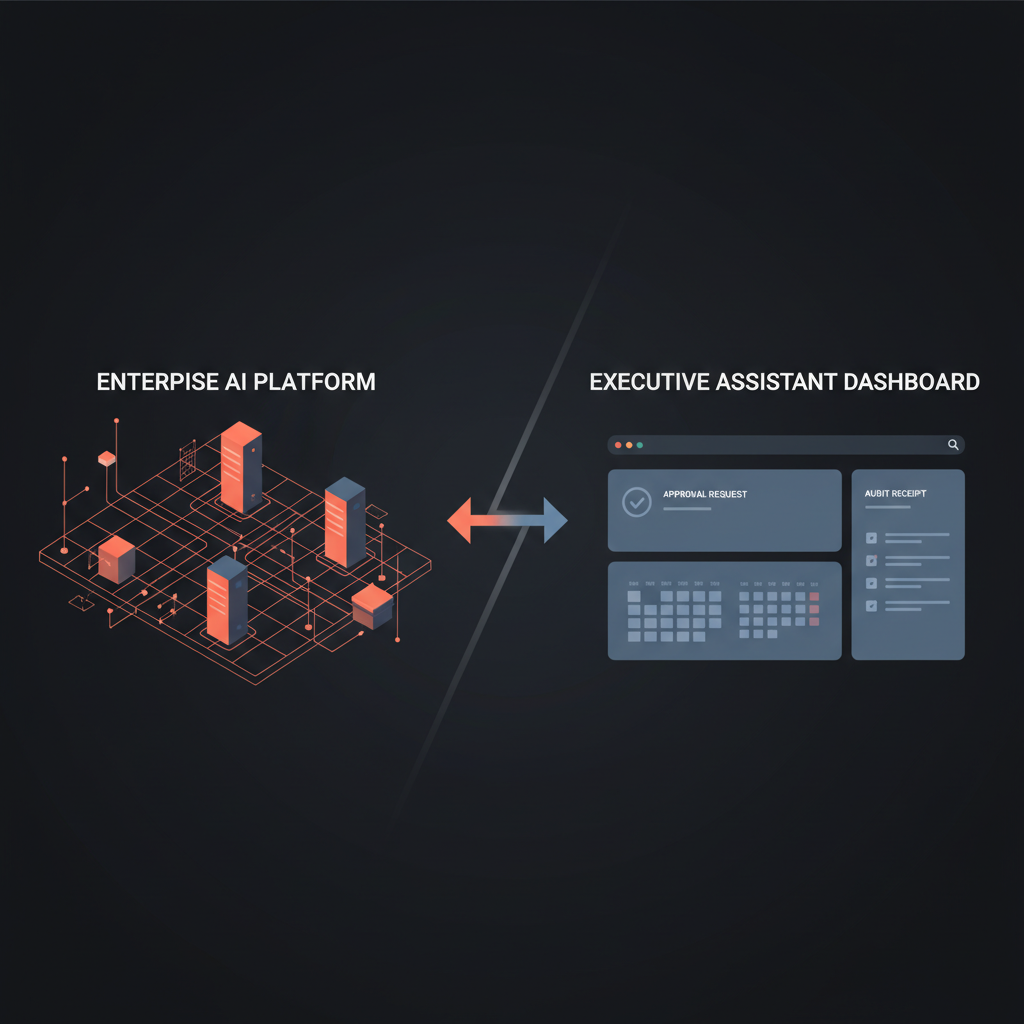
If you are evaluating NemoClaw and want the shortest honest answer, it is this: choose NemoClaw if you want an enterprise AI agent platform to build on; choose Alyna if you want an AI executive assistant that can safely handle executive work today. Those are related categories, but they are not the same purchase.
That distinction matters more than almost anything else in this comparison. A lot of buyers search for "NemoClaw alternative" when what they really mean is one of two things:
- "What should I use instead of a new enterprise agent platform?"
- "Do I actually need a platform, or do I need a working assistant for leaders and operators?"
This guide is written for the second group.
According to the public positioning on NemoClaw, the product is presented as NVIDIA's upcoming open-source enterprise AI agent platform, with strong emphasis on security, privacy, open-source customization, and integration with the NeMo and NIM ecosystem. That is a meaningful positioning shift from the more personal-agent framing around OpenClaw.
| Decision area | Alyna | NemoClaw |
|---|
| Best fit | Executives and teams who want a working AI executive assistant | Organizations that want enterprise agent infrastructure |
| Primary job | Delegate, draft, coordinate, approve, and execute | Build, customize, and deploy AI agents |
| Approval-first workflow | Default model | Depends on what you build |
| Time to value | Immediate executive workflow usage | Longer setup, design, and implementation cycle |
| Who should own it | Executive ops, founders, senior staff | Platform, IT, engineering, or AI infrastructure teams |
| Bottom line | Better NemoClaw alternative for executive delegation | Better if your goal is enterprise agent platform building |
If you want the direct compare page first, see Alyna vs NemoClaw. If you are exploring the self-hosted personal-agent side of the market instead, read our OpenClaw alternative guide.
Based on the public nemoclaw.bot positioning page, NemoClaw is framed as an enterprise AI agent platform rather than a consumer assistant. The site emphasizes:
- enterprise-grade security and privacy,
- open-source customization,
- agent deployment across the workforce,
- and integration with NVIDIA's AI ecosystem. Source
That framing is important because it changes the buyer question.
OpenClaw-style discussions are often about a powerful assistant that runs on your machine and can act in chat-first environments. NemoClaw-style discussions, by contrast, are about platform architecture:
- agent infrastructure,
- enterprise deployment,
- governance,
- customization,
- and ecosystem fit.
That may be exactly what an engineering or platform team wants. It is usually not what an executive means when they say, "I want an AI assistant to handle scheduling, follow-ups, research, and approvals."
The simplest reason is this:
a platform is not the same thing as an assistant.
Even if NemoClaw eventually becomes a strong enterprise platform, that does not automatically make it the best answer for executive delegation.
An enterprise agent platform is designed to let organizations build or deploy agents across teams and systems. That is valuable, but it is a different scope from:
- drafting sensitive emails,
- coordinating calendars,
- preparing briefing notes,
- handling browser-based admin tasks,
- and routing all of that through approvals and audit logs.
Executives usually do not want to buy a runtime layer when what they need is a reliable assistant behavior layer.
The public NemoClaw positioning stresses open-source flexibility and deep customization. Source That is attractive for enterprises that want control. It also implies a familiar trade-off:
- more control,
- more platform responsibility,
- more implementation decisions,
- and more internal coordination before users get value.
That may be the right answer for an internal AI platform team. It is usually the wrong answer for a founder or executive who wants useful delegation this quarter.
Buyers often blur these together.
A platform can be strategically interesting and still be the wrong operational fit for executive workflows. The test for an executive assistant is not "Does this platform have strong ecosystem positioning?" It is:
- Can it draft before sending?
- Can it coordinate across channels?
- Can it handle browser tasks safely?
- Can it leave receipts?
- Can it reduce cognitive load without introducing surprise?
That is the frame where Alyna wins.
Alyna is designed around one use case: helping leaders and operators delegate real work safely.
That means the value proposition is not "build your own agent platform." It is:
- draft first,
- approve before action,
- keep a visible trail,
- and make the assistant useful in real executive workflows.
The biggest difference between Alyna and a platform-style alternative is not a feature checklist. It is the workflow model.
With Alyna:
- the assistant proposes or drafts,
- you review,
- you approve,
- and only then does execution happen.
That sounds simple, but it completely changes risk management. For executive work, this is often the most important design choice in the whole product category. For the deeper argument, see approval workflows for executives.
Executive buyers care about outcomes like:
- inbox triage,
- calendar coordination,
- meeting prep,
- research summaries,
- follow-up drafting,
- browser workflows,
- and clear auditability.
Those are assistant outcomes. Alyna is built around those outcomes directly.
NemoClaw, by contrast, is presented as a platform layer for organizations that want to build and deploy agents in an enterprise setting. Source
This is where many comparisons quietly break down.
An enterprise platform may be strategically exciting, but the practical path to value is often longer:
- architecture decisions,
- governance decisions,
- deployment work,
- internal ownership,
- and integration work.
Alyna is better when the buyer wants the assistant result without first building an internal program around it.
- you are evaluating enterprise agent infrastructure,
- you have a platform, IT, or engineering team that wants to own deployment,
- you care about open-source customization more than ready-made assistant workflows,
- you are comfortable with a longer path from platform choice to end-user experience.
- you want an AI executive assistant rather than an agent platform,
- you need approval-first actions by default,
- you want executives and operators to use it immediately,
- you care about reducing risk and cognitive load in day-to-day work.
This is the same reason the topic deserves its own page rather than being folded into the OpenClaw cluster. The key question is different:
OpenClaw: "Is a self-hosted personal agent safe enough for executive use?"NemoClaw: "Do I need an enterprise agent platform, or do I need a working executive assistant?"
When buyers compare Alyna and NemoClaw, the most useful question is not "Which one is more advanced?"
It is:
Am I trying to buy a platform that my organization will build on, or am I trying to buy an assistant that can safely help executives now?
If the answer is platform, NemoClaw may be the more relevant category to watch.
If the answer is assistant, Alyna is the better alternative because it is already shaped around:
- approvals,
- accountability,
- executive workflow fit,
- and practical delegation.
That category alignment matters more than brand momentum.
Based on the public positioning at nemoclaw.bot, NemoClaw is presented as an upcoming open-source enterprise AI agent platform with strong emphasis on security, privacy, enterprise deployment, and integration with NVIDIA's broader AI stack.
Not really. NemoClaw is framed more like enterprise agent infrastructure, while Alyna is positioned as an approval-first AI executive assistant. They overlap at the broad "AI agents" level, but they solve different buyer problems.
Alyna is the stronger fit if the buyer wants executive-safe delegation, approvals, audit trails, and workflow coverage rather than a platform to build or deploy custom agents on top of.
Choose NemoClaw when the organization is explicitly looking for enterprise AI agent platform capabilities, open-source flexibility, and internal ownership of the deployment and customization model. If the goal is day-to-day executive assistance, Alyna is usually the more direct answer.
NemoClaw is interesting because it pushes the conversation away from personal-agent hype and toward enterprise agent infrastructure. That could matter a lot for large organizations.
But if you are an executive, founder, or senior operator trying to solve a simpler problem, "How do I get real assistant leverage without extra blast radius?", then the best NemoClaw alternative is not another platform.
It is Alyna, because Alyna is built for approval-first delegation, cross-channel executive workflows, and visible control over what gets done and what gets sent.
If that is the problem you are solving, start with Alyna vs NemoClaw or get access.