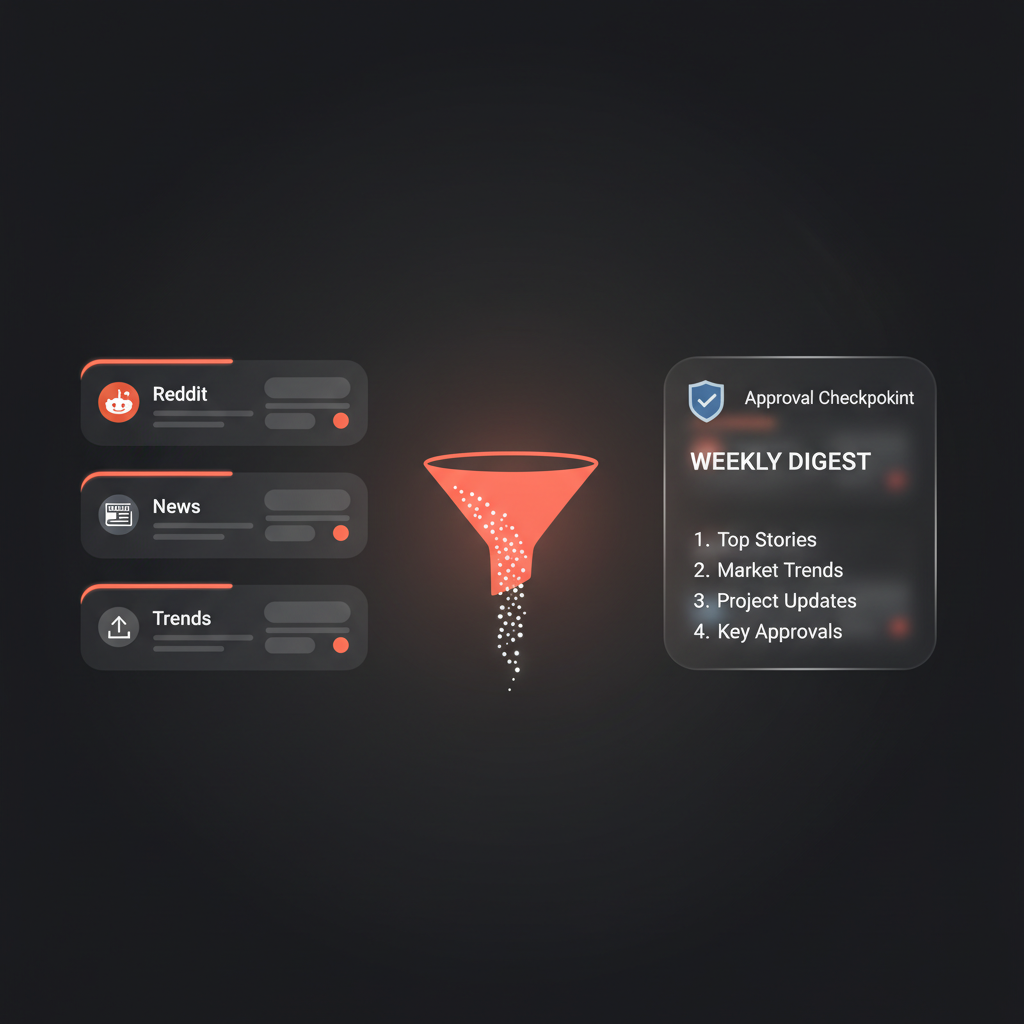
You need to stay current on companies, markets, and topics - but you don't have an hour every morning to scan Reddit, Google Trends, news APIs, and X. The result? You walk into meetings without the "what's happened in the last 30 days" context, or you waste time digging for it at the last minute.
A research pipeline fixes that: one ask (e.g. "last 30 days on [company/topic]") that runs on a schedule and lands in Slack or your inbox as a structured digest. The catch with DIY or open-source agents is that you own security, memory, and cost - and it's easy to end up with another inbox to babysit.
With Alyna, you get the same outcome without the ops: approval before anything is sent or published, persistent memory so your preferences stick, and a single place to define what "stay current" means for you. This post shows how to build that pipeline using Alyna so you stay informed without the noise.
Founders and executives are judged on context. A sales call where you know the prospect just raised a round or launched a product is different from one where you're winging it. A board meeting where you've seen the last 30 days of competitor moves is different from one where you're reacting to slides.
The problem isn't lack of sources - it's aggregation and consistency. You have Reddit, Google Trends, News API, X (if you use it), newsletters, and Slack. Nobody has time to hit all of them every day. So you either skip it and show up underprepared, or you do a frantic 30-minute scrape before key meetings.
A research pipeline flips that: you define once what you care about (e.g. "Twist 500 companies," "target accounts," "competitor X"), and the system finds updates in the last 24 hours (or 7/14/30 days), structures them (headline, link, one-line summary), and delivers on a schedule. You read one digest instead of five platforms.
To run a pipeline like this you need:
- Sources - e.g. Brave search, News API, Google Trends, YouTube, X (if available).
- Entities - the list of companies, topics, or people you care about (e.g. your portfolio, target accounts, competitors).
- Schedule - e.g. daily at 9am and 2pm so you have a digest when you sit down and before you publish or meet.
- Format - headline, link, one-line summary; no press releases or low-quality sources unless you add them.
- Memory - so the system remembers your preferences (e.g. "prefer X over Y," "always include link," "never use em-dashes") and doesn't repeat mistakes.
With Alyna, you don't host anything or tune models. You give Alyna your list of sources and entities, instruct it on schedule and format, and refine with feedback. Alyna's unlimited memory keeps your preferences; approval-first means nothing is sent or published without your review. You get the pipeline without a second inbox or a devops project.
Tell Alyna what you want to track. Examples:
- "Track updates for these 50 companies: [list or link to Notion/Sheet]."
- "I care about: [topic A], [topic B], [competitor X]. Use Reddit, Google Trends, News API, and [any other source you've connected]."
Be specific about what counts as an update: e.g. "last 24 hours" for a daily digest, or "last 30 days" for a weekly deep dive. Clarify what to exclude: e.g. "No press releases unless it's funding or product launch," "No low-quality sources."
With Alyna you can set a recurring brief (e.g. daily or twice daily). Instruct Alyna:
- "Every [day/time], find updates in the last 24 hours for [list]. Output: headline, link, one-line summary. Send to [Slack channel / email]. Do not publish anywhere public without my approval."
Alyna runs on the schedule and queues the digest for your approval; you review and approve so it lands where you want (Slack, email, or internal doc). No accidental posts or sends.
Use natural feedback so the pipeline improves:
- "Remember: prefer [source X] over [source Y] for funding news."
- "Always include the link; never use em-dashes in the summary."
- "For [company Z], that story was wrong - they didn't raise; skip that source next time."
Alyna's memory stores these preferences so tomorrow's digest is better. You're not re-teaching a chatbot every session; you're training a pipeline that gets smarter over time.
- Sales and business development - "Last 30 days on [prospect company]" before every call. With Alyna you get one digest per prospect or per segment, approval before anything is shared, and no manual scraping.
- Portfolio and investment - "Last 24 hours on [portfolio companies]" so you're never surprised in LP or board updates. Alyna can pull from your connected tools and deliver to a private channel or email.
- Competitive and market intel - "Last 7 days on [competitor X] and [market Y]." One place, one format, on your schedule - with Alyna handling the aggregation and you keeping final say on what gets distributed.
- Approval before any action - No risk of the pipeline posting to the wrong channel or emailing the wrong list. You review the digest and approve where it goes.
- One place for instructions and memory - No scattered prompts or config files. Alyna keeps your pipeline definition and your refinements in one place, with a full audit trail of what ran and what was approved.
- No ops or token tuning - You don't host servers or optimize model routing. Alyna handles reliability and cost so you can focus on what to track and how to use the digest.
A "stay current" pipeline should make you better informed, not more busy. With Alyna you get exactly that: a repeatable research pipeline that runs on your schedule, respects your preferences, and never sends or publishes without your approval.
Alyna is an AI executive assistant that can run research pipelines, daily briefs, and multi-step workflows - all approval-first with full audit trails. See how Alyna works as your AI Chief of Staff.