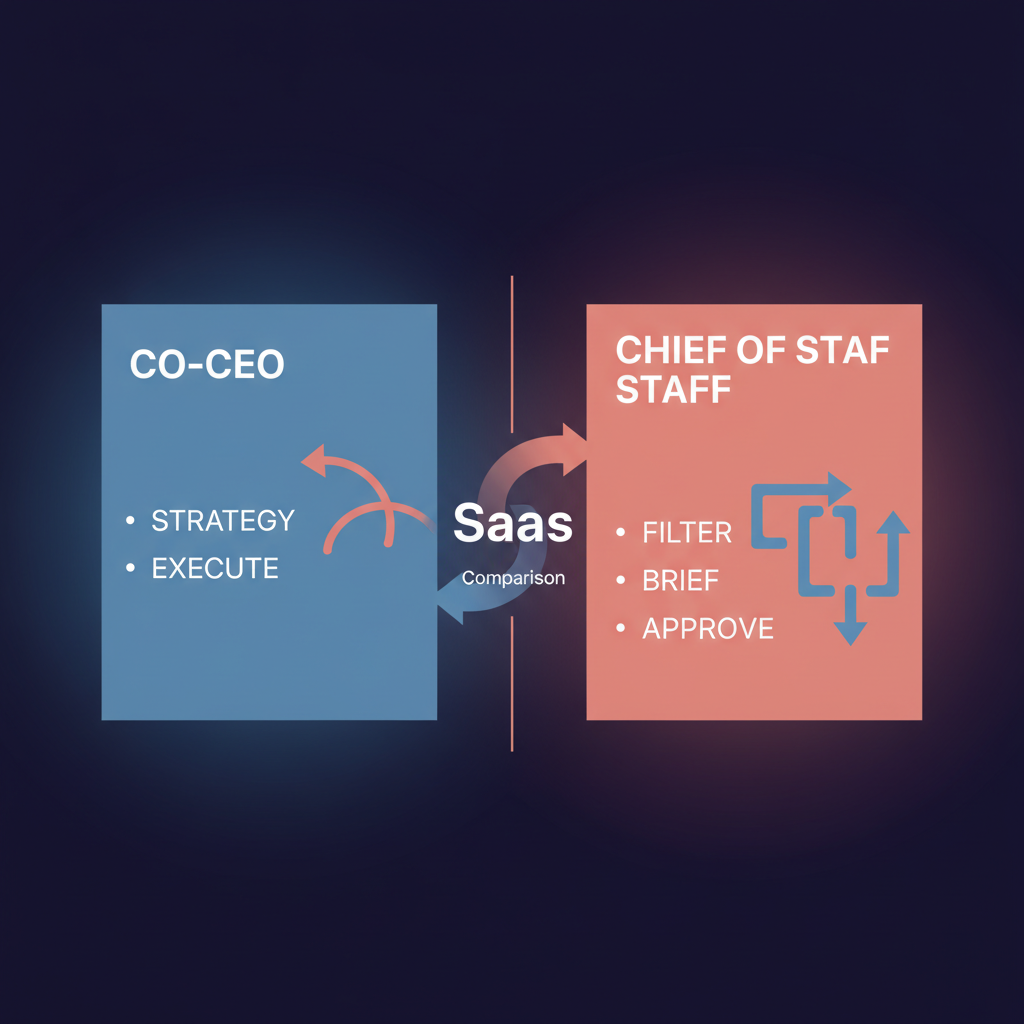
Most founders do not need an AI co-CEO. They need an AI that clears the operational fog: triages the inbox, prepares decisions, turns meetings into follow-through, and drafts the message before they send it. That is much closer to an AI Chief of Staff than an AI Co-CEO. This page is intentionally a decision-rights framework, not a generic chief-of-staff explainer. The goal is to help founders decide where autonomy belongs and where approval should begin.
The simplest way to frame the difference is this:
An AI Co-CEO is a high-autonomy strategic operator. An AI Chief of Staff is a high-context execution layer that prepares work and waits for approval.
That distinction matters because the market is moving toward more capable agents. OpenAI defines agents as systems that independently accomplish tasks on a user's behalf, while Anthropic distinguishes between fixed workflows and agents that dynamically direct tool use. At the same time, enterprise buyers are becoming more explicit about oversight, accountability, and intervention. Microsoft's 2025 Work Trend Index argues that the future of work is human-agent teams, not pure automation. For founders, that means the real decision is not "Do I want AI?" It is "Where should autonomy stop, and where should my approval begin?"
For most busy operators, the answer is clear: strategy can be supported by AI, but external execution should usually remain approval-first. For adjacent reading, see AI Chief of Staff guide 2026, AI executive assistant for solo founders, and personal AI workers 2026.
"AI Co-CEO" is not a standard operating role. It is a product label for an AI system that sits unusually close to the executive decision layer. In practice, that usually means some combination of:
- cross-functional research and synthesis
- prioritization recommendations
- scenario analysis and trade-off framing
- orchestration across tools or teams
- occasional autonomous execution of follow-ups or workflows
The appeal is obvious. If AI can reason across context, delegate work to tools, and keep projects moving, it can feel like a second executive brain. That story fits the current "digital labor" narrative: Microsoft reports that 82% of leaders expect to use digital labor to expand workforce capacity in the next 12 to 18 months, and OpenAI reports that usage of structured workflows such as Projects and Custom GPTs rose 19x year-to-date in 2025.
But there is a catch: the closer AI gets to decision rights and outward-facing execution, the more you need governance, not just capability.
An AI Chief of Staff maps more cleanly to a real-world role. A chief of staff traditionally coordinates the executive front office, manages briefs, reviews documents for signature, tracks priorities, and keeps work moving across stakeholders. The Center for Presidential Transition's role description captures the essence well: travel, briefing, schedule, message, special projects, and review of documents for signature.
Translated into AI, that means an assistant that:
- filters what reaches you
- packages context into useful briefs
- drafts communications and next steps
- follows up across projects and stakeholders
- keeps a queue of proposed actions for your review
This is the key difference: the AI Chief of Staff prepares decisions and actions, but does not claim the right to make them on your behalf.
| Dimension | AI Co-CEO | AI Chief of Staff |
|---|
| Core promise | Strategic partner with wider autonomy | Operational leverage with executive control |
| Primary value | Analysis, prioritization, orchestration | Triage, briefing, drafting, coordination, follow-through |
| Typical posture | "Set the goal and let it run" | "Prepare the work, then let me approve" |
| Best on | Internal research, scenario modeling, workflow orchestration | Inbox, calendar, meeting prep, follow-ups, approvals |
| Failure mode | Blurred accountability, overreach, silent execution | Queue friction, slower throughput on final approval |
| Who should use it | Founders comfortable with more autonomy in bounded environments | Founders who want leverage without losing the final say |
Plain-English rule: if the tool will touch customers, candidates, investors, money, or your calendar in a way that creates commitments, you usually want the Chief of Staff model.
In most cases, founders are not actually asking for a second CEO. They are asking for relief from four recurring pains:
- Too many inbound messages and decisions.
- Too much context switching between email, calendar, docs, and Slack.
- Too many meetings that end without follow-through.
- Too much founder attention spent on coordination instead of judgment.
Those are Chief of Staff problems more than Co-CEO problems.
If your pain is "I need better thinking," an AI co-CEO-style tool can help with analysis. If your pain is "I need the machine to turn chaos into an approval queue," an AI Chief of Staff is the better category.
Do not choose based on branding. Choose based on decision rights, reversibility, and operating risk.
Use a more autonomous system for:
- internal research
- competitive analysis
- summarizing documents
- drafting memos or strategic options
- exploring scenarios you will review later
Use an approval-first chief-of-staff layer for:
- sending email
- scheduling or rescheduling meetings
- recruiting outreach
- partner or customer communication
- travel bookings
- investor updates
The dividing line is simple: thinking can be more autonomous than acting.
If the AI makes a bad internal summary, you can ignore it. If it sends the wrong investor follow-up, confirms the wrong meeting, or messages a candidate at the wrong time, the mistake is external, social, and often difficult to undo.
OpenAI's governance paper on agentic systems explicitly calls out constraining action space, requiring approval, making agent activity legible, and maintaining interruptibility. That is exactly the right lens for executive workflows.
The slogan "AI co-CEO" sounds efficient until you ask the operational question: who owns the mistake?
NIST's AI Risk Management Framework centers governance, risk ownership, and lifecycle management rather than treating AI output as self-justifying. Likewise, the EU AI Act's Article 14 on human oversight emphasizes that people assigned oversight should be able to understand system limitations, interpret outputs, override them, and intervene or stop the system when needed.
Even when an executive assistant use case is not formally classified as high-risk AI, serious buyers are increasingly using this oversight standard anyway.
Strategy work benefits from synthesis. Relationship work depends on nuance.
An AI can help you think through:
- market entry priorities
- pricing hypotheses
- operating metrics
- hiring plans
- weekly leadership agendas
But it is weaker at:
- sensing hidden political context
- understanding interpersonal history
- judging when not to send the message
- handling sensitive communication where tone is the outcome
That is why "AI as chief of staff" is more robust than "AI as co-CEO" for most founders: it keeps the machine on the preparation side of the line.
An AI co-CEO can be useful. It can also fail in predictable ways.
The more the system is allowed to act across tools and teams, the easier it becomes for responsibility to blur. When a workflow is partly autonomous and partly supervised, postmortems get harder: was the problem the recommendation, the instruction, the permission scope, or the operator?
Many tools advertise "human in the loop" when they really mean "someone could intervene if they noticed." That is not the same as explicit approval. In high-stakes executive workflows, weak oversight often produces the worst of both worlds: the operator assumes control exists, but the system still moves faster than review.
Co-CEO-style framing pushes products toward initiative and speed. That can be useful in internal environments. It is much less useful when the highest-value move is restraint, delay, or escalation to a human.
The AI Chief of Staff model is not exciting because it is grand. It is exciting because it is operationally correct.
It gives founders leverage where they actually need it:
- the inbox becomes a prioritized queue instead of a stream
- meetings become briefs before and follow-ups after
- scheduling becomes propose-review-confirm instead of endless back-and-forth
- projects become visible and traceable instead of scattered across apps
It also creates a cleaner control surface. The AI can do a lot of work before you ever see it, but the consequential step is still yours. That makes training easier, trust easier, and auditability easier.
OpenAI's enterprise report found that workers report saving 40 to 60 minutes per day with AI, and heavy users report more than 10 hours per week. Those gains are real, but the lasting gains come from structured workflows, not novelty. An AI Chief of Staff is a structured workflow product.
If you want the strongest version of both models, use this split:
| Layer | Recommended autonomy |
|---|
| Research, synthesis, background analysis | High autonomy |
| Drafting memos, follow-ups, meeting briefs | Medium autonomy |
| Sending messages, confirming meetings, external coordination | Approval-first |
| Anything involving money, legal exposure, candidate decisions, or customer promises | Explicit approval plus audit trail |
This is the pattern that scales. Let AI think broadly, prepare aggressively, and surface options quickly. Keep the executive as the final checkpoint for actions that create commitments.
That is also the strongest positioning for Alyna: not "AI replaces the executive," but "AI removes the operational drag while preserving executive control."
Ask these questions before you buy:
- Do I want better strategic analysis, or less operational drag?
- Will this tool only advise, or will it execute?
- Which actions can happen without my approval?
- Can I see exactly what was proposed, edited, approved, rejected, and sent?
- If something goes wrong, can I reconstruct who decided what?
If you cannot answer those questions clearly, you are not choosing a category. You are buying a demo.
- AI Co-CEO is a market label for a more autonomous executive-style agent: useful for analysis and orchestration, but risky when decision rights and execution blur together.
- AI Chief of Staff is the more practical operating model for most founders: filter, brief, draft, coordinate, follow up, and wait for approval before external action.
- The real decision is not "strategy vs ops." It is where autonomy ends and executive accountability begins.
- For internal analysis, broader agent autonomy can work well. For customer, investor, recruiting, calendar, and other commitment-creating actions, approval-first is usually the better design.
- The safest high-leverage setup is: AI prepares broadly, human approves consequential actions, system keeps the audit trail.
Alyna is built around that model: draft-first, approve-before-send, with executive control preserved at the action layer. If you want the deeper operating model, continue with AI Chief of Staff guide 2026, approval workflows for executives, and how to pair a human EA with an AI assistant.
Alyna is your AI Chief of Staff: draft-first, you approve, full audit trail. Get access.