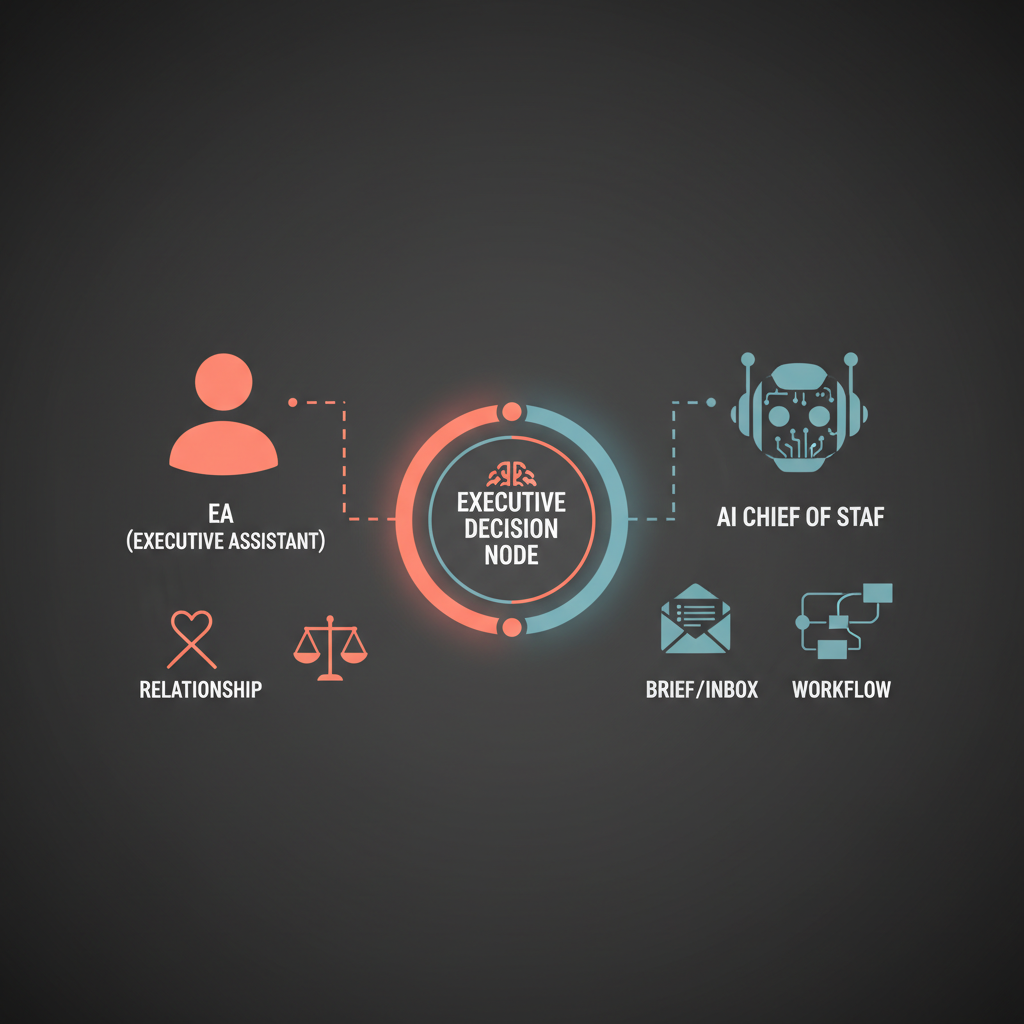
The strongest reason to pair a human EA with an AI Chief of Staff is not generic "hybrid work." It is executive-office service design. The office of the executive is a capacity system: requests arrive across inbox, calendar, meetings, follow-through, stakeholder management, and exception handling, and the question is whether the office can absorb that load without letting the executive become the bottleneck. In 2026, many offices need more than a handoff model. They need a coverage model. Microsoft's 2025 Work Trend Index frames the future around human-agent teams and task-specific human-agent ratios, while McKinsey's work on the agentic organization emphasizes operating-model redesign rather than bolt-on automation.
This article is therefore about service architecture for the executive office: where the AI Chief of Staff becomes an office layer, how one EA plus AI can stretch coverage, what SLAs make the model workable, and how to support multiple executives or especially high-complexity leaders. If you want the more tactical handoff-and-review article, read How to Pair a Human EA with an AI Assistant. If you are evaluating the category itself, compare this with AI Chief of Staff, AI executive assistant, and approval workflows for executives.
The wrong question is:
"Should the AI or the EA own this task?"
The better question is:
"What service model gives this executive office enough coverage, speed, and control at the current volume and complexity?"
That shift matters because executive support is not one job. It is a service stack that includes:
- intake and triage
- briefing and context assembly
- calendar and coordination management
- follow-through and reminder logic
- stakeholder-sensitive exceptions
- approval and commitment control
OECD guidance on AI in the workplace is useful here because it frames workplace AI around accountability, oversight, and human agency. In executive support terms, the AI layer should increase throughput and consistency, while the human EA keeps judgment, sequencing, and stakeholder discretion intact.
An AI Chief of Staff is not just a drafting assistant sitting next to the EA. In a service-design model, it acts as an office layer that does four things continuously:
- Absorbs first-pass volume. It handles repetitive prep, triage, briefing assembly, and follow-through packaging.
- Creates a common queue. It turns scattered signals from inbox, calendar, meetings, and notes into one operating surface.
- Normalizes service quality. It gives the office repeatable formats for briefs, drafts, handoffs, reminders, and approvals.
- Extends coverage hours without pretending to extend judgment. It can keep work organized between live human review windows, but it should still stop at consequence.
That is different from the human EA role. The EA remains the service owner for discretion, exception handling, executive protection, stakeholder nuance, and escalation decisions.
Before choosing a coverage model, assess the office on three dimensions:
| Dimension | What high means | Why it changes the model |
|---|
| Volume | High request flow, many meetings, heavy follow-up load, frequent reschedules | The office needs more first-pass capacity and queue discipline |
| Complexity | Many cross-functional dependencies, multi-party coordination, or changing priorities | The office needs stronger triage and briefing support |
| Consequence | More external commitments, investor or customer exposure, or politically sensitive decisions | The office needs tighter approval and exception handling |
When volume rises, the AI layer usually becomes more valuable. When consequence rises, the human EA becomes more valuable. When both rise at once, the office often needs a formal EA + AI Chief of Staff model rather than ad hoc tool usage.
The useful promise of AI is not that one EA can support an unlimited number of executives. The more credible claim is narrower:
One strong EA plus an AI Chief of Staff can usually absorb more low-consequence coordination volume before service quality breaks.
Why? Because the AI can take first pass on:
- morning brief assembly
- recurring meeting prep
- low-risk draft generation
- follow-up packaging
- scheduling proposals
- reminder and queue hygiene
That lets the EA spend more of the day on:
- priority trade-offs
- sensitive stakeholder routing
- exception handling
- sequencing and executive protection
- quality control on consequential outputs
The scaling logic should therefore be read as capacity relief, not labor substitution. If the executive office is already failing because of political complexity, weak approvals, or relationship-heavy work, AI alone will not fix the model.
Most buyers should choose a service model intentionally rather than stumbling into one.
| Service model | Best for | What it looks like | Main risk |
|---|
| Single-executive augmented office | One leader with moderate complexity | One EA remains service owner; AI handles first-pass prep and queue formation | AI stays a sidecar and never changes service capacity |
| One-EA-plus-AI scaled office | One leader with high volume or two leaders with similar operating patterns | EA owns judgment and priority; AI standardizes prep, triage, and follow-through across both books of work | The EA becomes the hidden bottleneck if review rules are unclear |
| Executive-office hub-and-spoke | Multiple executives with shared admin patterns | One EA or small EA team uses AI as the common intake and prep layer, with escalation rules by executive | Service quality becomes uneven if preferences are not captured cleanly |
| High-complexity office pod | CEO, founder, investment partner, or externally intensive leader | EA + AI Chief of Staff + executive operate as a formal service pod with explicit SLAs and approval boundaries | The office becomes over-engineered if every request is treated as bespoke |
For many buyers, the most interesting middle ground is one-EA-plus-AI scaled office. It is where the AI layer starts acting like shared service infrastructure rather than a personal productivity tool.
Service design gets practical when you define coverage windows and response expectations.
Use a framework like this:
| Coverage lane | AI Chief of Staff | Human EA | Executive |
|---|
| Always-on intake | Collects requests, summarizes, classifies, and forms the queue | Reviews exceptions and reprioritizes | Sees only what rises above threshold |
| Daily brief production | Assembles draft brief and open loops | Edits for context, sequence, and emphasis | Consumes and decides |
| Coordination throughput | Produces first-pass schedules, follow-ups, and prep packets | Resolves trade-offs and stakeholder sensitivities | Approves consequential commitments |
| Exception desk | Flags ambiguity, confidence gaps, and policy triggers | Owns red-category decisions and routing | Handles true edge cases |
| After-hours continuity | Keeps the queue organized and ready for the next review window | Maintains final control boundaries | Stays out unless interruption thresholds are met |
That is what makes the model distinct from a generic hybrid article. The point is not just who edits what. The point is how the office preserves service continuity without expanding human bandwidth linearly.
An executive-office service model is only real if it has service levels.
Examples of practical SLAs:
| Service area | Example SLA |
|---|
| Morning brief | Delivered in a standard format before the executive's first decision block |
| Low-risk coordination drafts | Prepared within the same business day and routed to the right reviewer |
| Meeting prep | Ready a fixed number of hours before external or high-priority meetings |
| Scheduling conflicts | Proposed options surfaced within a defined response window |
| Escalations | Sensitive items routed to the EA immediately, not buried in general triage |
| Follow-through | Action drafts and reminders packaged the same day as the triggering meeting |
These are not bureaucratic add-ons. They are what let one office support more demand without dissolving into invisible queue work.
Do not add a formal AI Chief of Staff layer just because the executive likes AI.
Add it when one or more of these signals are true:
- the EA spends too much time assembling context instead of exercising judgment
- the office is missing follow-through because work arrives from too many places
- daily brief, prep, and coordination work is frequent enough to benefit from standardized formats
- the executive wants more coverage but does not want more interruptions
- multiple executives share support patterns that could run on one queue and one rule system
In other words, add the layer when the office needs shared operating infrastructure, not merely faster drafting.
Multi-executive coverage is where service design matters most.
A practical model is:
- Use the AI Chief of Staff as the common intake, prep, and queue-formation layer.
- Keep one human EA or office lead responsible for cross-executive priority conflicts.
- Capture executive-specific preferences, hard-stop stakeholders, and escalation triggers explicitly.
- Standardize the service format even when the political context differs by executive.
For multiple executives, the biggest operational risk is not that the AI drafts badly. It is that the office loses clarity on whose priorities win, which requests can wait, and which stakeholders always require a human decision. That is why coverage design matters more than generic automation.
Some leaders do not just have more work. They have more consequential work.
Examples include:
- CEOs with investor and board exposure
- founders balancing fundraising, recruiting, and customer escalation
- investment partners with dense external calendars
- customer-facing executives where tone and timing change commercial outcomes
For those leaders, the right model is often an office pod:
- AI Chief of Staff for intake, prep, drafting, and queue hygiene
- human EA for service ownership, exception control, and stakeholder sequencing
- executive for final decision rights on commitments and interruptions
The AI increases throughput. The EA protects the office from making the wrong thing easier.
No matter how strong the AI layer gets, keep these human-led:
- high-stakes stakeholder sequencing
- board, investor, legal, and personnel-sensitive decisions
- interruption thresholds
- trade-offs between competing executive priorities
- final approval on consequential outward commitments
This is also why approval-first AI assistants matter in an executive-office service model. Without explicit approval boundaries, the office loses visibility into where throughput ended and delegated authority began.
Do not choose a formal human-EA-plus-AI-Chief-of-Staff design if:
- the executive's support load is still simple and low-volume
- there is no disciplined human owner for the office queue
- the organization mainly needs broad productivity tooling, not executive-office redesign
- leadership expects AI to remove judgment work rather than absorb prep volume
- the team is unwilling to maintain service levels, review windows, and escalation rules
A service model can also fail if the office duplicates work. If the AI prepares the brief, the EA rebuilds it, and the executive still re-asks for everything live, the model is not scaling. It is just adding layers.
The case for human EA + AI Chief of Staff is strongest when the executive office needs a better service model, not another tool. The AI layer adds first-pass capacity, queue structure, and format consistency. The human EA keeps judgment, exception handling, and stakeholder discretion where they belong.
That is what makes the pairing valuable. It is not just a hybrid handoff. It is a way to redesign executive-office coverage so one office can absorb more demand without surrendering control.
No. The better claim is that AI can increase first-pass capacity and service consistency, which may let one EA support more coordination volume before quality breaks. It does not eliminate the need for human judgment or office ownership.
When it is responsible for continuous intake, common queue formation, repeatable brief and draft formats, and the service infrastructure that multiple workflows or executives rely on every day.
The EA should still own exception handling, priority trade-offs, stakeholder nuance, executive protection, and the judgment required when the formal rules stop being enough.
Treating it as a handoff exercise instead of a service-capacity design problem. If the office does not define coverage, SLAs, and escalation ownership, the AI will add activity without adding reliable service.
Alyna fits this model as the AI Chief of Staff layer: prep, draft, route, and queue work for review while the human EA and executive keep the judgment and final control. See the AI Chief of Staff page and approval workflows for executives for the practical operating mechanics.